Common OSCE stations and scenarios, with practice cases
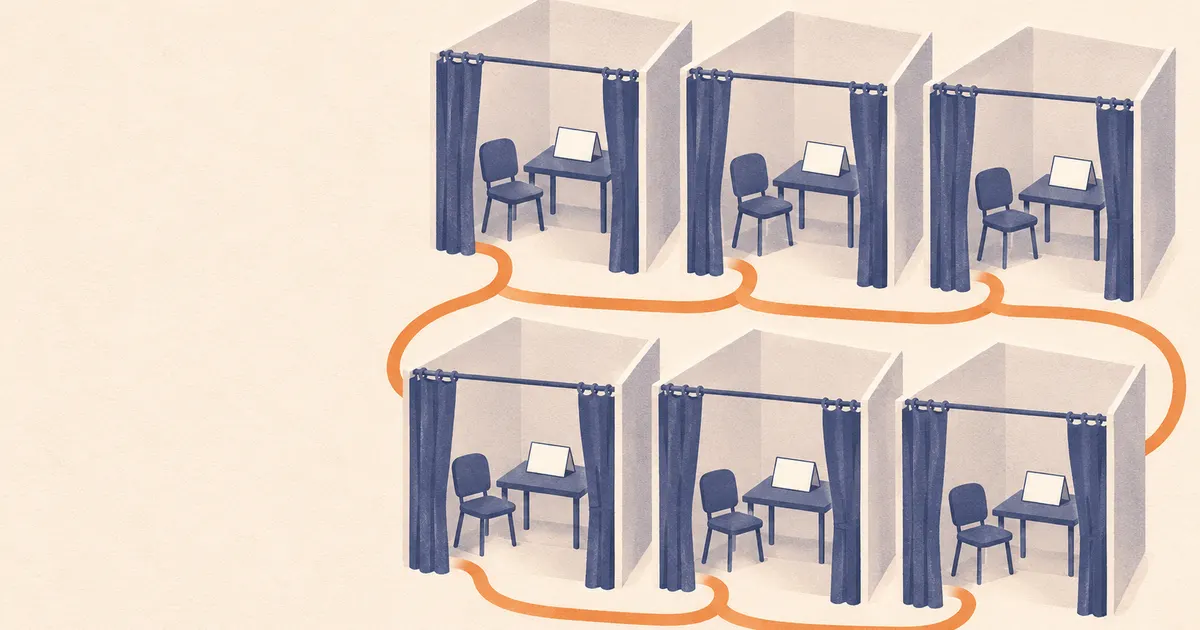
An Objective Structured Clinical Examination (OSCE) tests clinical tasks under time pressure, such as taking a history or explaining a plan. This post groups common OSCE stations and scenarios into 8 main types and shows what examiners look for in each. Each section links to free practice cases with answers and mark schemes so you can build a balanced revision list.
What an OSCE station is
An OSCE is a circuit of timed practical stations. Station length differs between exams, so check the timing in your own exam guide. Before you enter, you read a door note (also called a vignette) that gives the patient details, setting, and task. Inside, you speak with a simulated patient, examine a volunteer or manikin, or review clinical data while an examiner marks you.
Medical schools and licensing boards set different circuits, so always check your own exam blueprint first. In the UK, every medical student must pass the General Medical Council (GMC) Medical Licensing Assessment (MLA) as part of their degree. The MLA content map sets the topics for both parts: the Applied Knowledge Test (AKT) and the Clinical and Professional Skills Assessment (CPSA).
International doctors take the Professional and Linguistic Assessments Board (PLAB) test, which uses the same content map. Students sitting the Australian Medical Council (AMC) clinical exam, US assessments, or Singapore medical school exams should match their local syllabus.
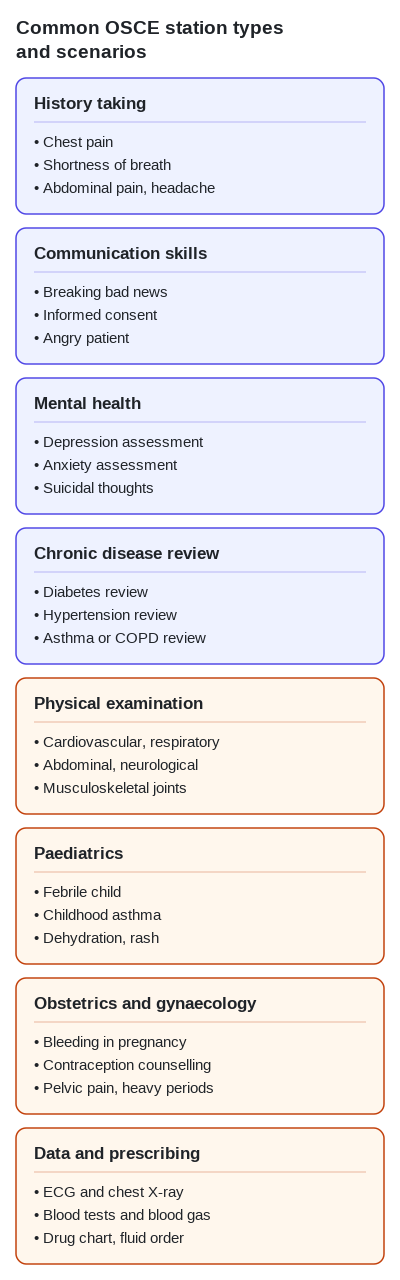
| Station type | Main task | Practice format |
|---|---|---|
| History taking | Gather a focused history and give a safe plan | Free written cases and spoken practice |
| Physical examination | Perform a system exam and report signs | Hands-on practice with a partner or lab |
| Communication skills | Share news, take consent, or handle conflict | Free written cases and spoken role-play |
| Mental health | Assess mood, thoughts, and safety | Free written cases and spoken role-play |
| Chronic disease review | Check control, adherence, and complications | Free written cases and spoken role-play |
| Paediatrics | Interview a parent and safety net clearly | Free written cases and spoken role-play |
| Obstetrics and gynaecology | Take a sensitive history and counsel | Free written cases and spoken role-play |
| Data and prescribing | Interpret results or write safe prescriptions | Past papers, mock charts, and formulary |
History taking stations
History taking stations are commonly set in OSCE circuits. You interview a simulated patient, then present a brief summary, differential diagnosis, and initial plan to the examiner. Commonly set scenarios include:
- Acute chest pain (chest pain cases, plus our guide on how to take a chest pain history in an OSCE)
- Shortness of breath, cough, or wheeze (shortness of breath cases and respiratory cases)
- Acute or chronic abdominal pain, altered bowel habit, or bleeding (abdominal pain cases and gastrointestinal cases)
- Headache, collapse, or acute confusion (headache cases, collapse and syncope cases, confusion and delirium cases, and neurological cases)
- Back pain, joint pain, or limb weakness (back pain cases, joint pain cases, and musculoskeletal cases)
- New skin rashes or changing lesions (skin rash cases and dermatological cases)
- Urinary symptoms, palpitations, weight change, or fatigue (genitourinary cases, cardiovascular cases, and endocrine cases)
Examiners usually mark both what you ask and how you ask it. The Calgary-Cambridge guide sets out how to combine this clinical content with the interview process. They look for a clear opening, targeted questions that rule out red flags early, and the patient's Ideas, Concerns and Expectations (ICE). At the end, they want a logical differential diagnosis and safe immediate steps rather than a long list of rare conditions.
Physical examination stations
Physical examination stations test whether you can examine a body system smoothly, safely, and respectfully under time pressure. Commonly set scenarios include:
- Cardiovascular examination (inspection, pulses, jugular venous pressure, and heart sounds)
- Respiratory examination (inspection, chest expansion, percussion, and auscultation)
- Abdominal examination (inspection, palpation for tenderness or organomegaly, percussion, and auscultation)
- Neurological examinations, including upper limb, lower limb, gait, and cranial nerves
- Musculoskeletal examinations of the hand, knee, hip, shoulder, or spine
- Thyroid and peripheral vascular examinations
Examiners look for a fluent routine, clear instructions to the patient, and attention to comfort and dignity. They also check whether you spot abnormal signs, describe them accurately, and suggest sensible next investigations.
Our free cases are history and communication cases, not physical examinations, so practice examinations hands-on with a partner or in your skills lab. You can pair that practice with matching history cases in cardiovascular, respiratory, gastrointestinal, neurological, and musculoskeletal topics.
Communication skills stations
Communication stations test how you share difficult or complex information with a patient or relative. You rarely need to make a diagnosis from scratch because the door note gives you the clinical background. Commonly set scenarios include:
- Breaking bad news, such as a new cancer diagnosis or scan progression (breaking bad news cases)
- Taking informed consent before a procedure or operation (consent cases)
- Managing an angry or frustrated patient or family member (angry patient cases)
- Explaining a new diagnosis, test result, or treatment choice, including contraception (contraception counselling cases)
- Disclosing a medical error or discussing discharge arrangements
Examiners look for plain, jargon-free language, steady empathy, and regular checks of what the patient understands. For breaking bad news, frameworks such as SPIKES (Setting, Perception, Invitation, Knowledge, Emotions, Strategy and Summary) help you pace the talk. For consent stations in the UK, base your approach on the GMC guidance Decision making and consent (paragraph 10). Cover the options, including doing nothing, what each involves, and its potential benefits, risks of harm, and uncertainties.
Mental health stations
Mental health stations assess how safely and respectfully you explore psychological symptoms and risk. Commonly set scenarios include:
- Assessing low mood and possible depression (depression assessment cases)
- Assessing persistent worry, panic attacks, or phobias (anxiety assessment cases)
- Assessing suicidal thoughts or recent self-harm (suicidal ideation cases)
- Taking a history of psychosis, mania, or alcohol and drug use
- Assessing acute confusion or memory loss (confusion and delirium cases)
Examiners look for calm, non-judgemental questioning, direct exploration of mood and thoughts, and clear attention to safety. For a person who has self-harmed, National Institute for Health and Care Excellence (NICE) guideline NG225 advises against risk scales. It also advises against low, medium, or high risk ratings to predict suicide or to decide who gets treatment. Focus instead on the person's needs and their immediate and longer-term safety. Consider agreeing a safety plan: warning signs, coping strategies, people to contact, crisis numbers, and keeping the environment safe.
Chronic disease review stations
Chronic disease stations reflect everyday primary care and outpatient follow-up appointments. Commonly set scenarios include:
- Type 2 diabetes follow-up, medication adherence, and complication checks (diabetes review cases)
- Hypertension review, home blood pressure readings, and lifestyle support (hypertension review cases)
- Adult asthma or chronic obstructive pulmonary disease (COPD) review, including inhaler technique (respiratory cases)
- Multimorbidity and primary care follow-up consultations (Singapore family medicine cases)
Examiners look for a collaborative review of symptom control, medication side effects, and practical barriers to adherence. They also check that you screen for long-term complications, agree on realistic goals, and arrange clear follow-up.
Paediatrics stations
Paediatrics stations often involve speaking with a parent or carer, sometimes with a child present in the room. Commonly set scenarios include:
- Assessing a febrile child and checking for signs of serious illness (febrile child cases)
- Reviewing childhood asthma, inhaler spacer use, and triggers (childhood asthma cases)
- Evaluating vomiting, diarrhoea, and hydration in an infant or toddler
- Taking a feeding, growth, developmental, or immunisation history
- Assessing a childhood rash (skin rash cases)
Examiners look for warm rapport with both parent and child. They check focused questions on feeding, fluids, wet nappies, activity level, birth history, and immunisations. They also expect specific safety netting so the parent knows which warning signs need urgent review.
Obstetrics and gynaecology stations
Obstetrics and gynaecology stations test your ability to take a sensitive history and counsel clearly on reproductive health. Commonly set scenarios include:
- Bleeding in early or late pregnancy (pregnancy bleeding cases)
- Contraception counselling and checking medical eligibility (contraception counselling cases)
- Heavy menstrual bleeding, pelvic pain, or absent periods
- Antenatal booking history or explaining routine screening tests
- Menopausal symptoms and hormone replacement therapy counselling
Examiners check that you ask sensitively about the last menstrual period, pregnancy status, cervical screening, contraception, and sexual history. They also check for red flags, such as features of a possible ectopic pregnancy in early pregnancy bleeding, and clear next steps.
Data interpretation and prescribing stations
Some OSCEs include stations where you interpret clinical results or write prescriptions without a simulated patient. In the UK, prescribing is also tested in a separate online exam, the Prescribing Safety Assessment (PSA). Commonly set scenarios include:
- Interpreting an ECG, such as atrial fibrillation, heart block, or acute myocardial infarction
- Reading an arterial blood gas (ABG) or blood panel (electrolytes, renal function, liver enzymes, or full blood count)
- Reviewing a chest X-ray alongside a short clinical vignette
- Writing an inpatient drug chart, intravenous fluid order, or discharge summary
- Adjusting doses for renal impairment, spotting drug interactions, or counselling on a high-risk medicine
Examiners look for a systematic reading of the data, clear links to the vignette, and safe, legible prescribing. They check allergies, patient details, doses, routes, and frequencies. They also expect you to consult your local formulary, such as the British National Formulary (BNF) in the UK, rather than guessing. Our free cases focus on spoken consultations, so practice data and prescribing tasks with past papers and mock charts.
How to use OSCE practice cases
Reading a case and its mark scheme from top to bottom shows you the answer before you have tried to recall it. Treat each written case as a timed station first, then use the answer to find specific gaps.
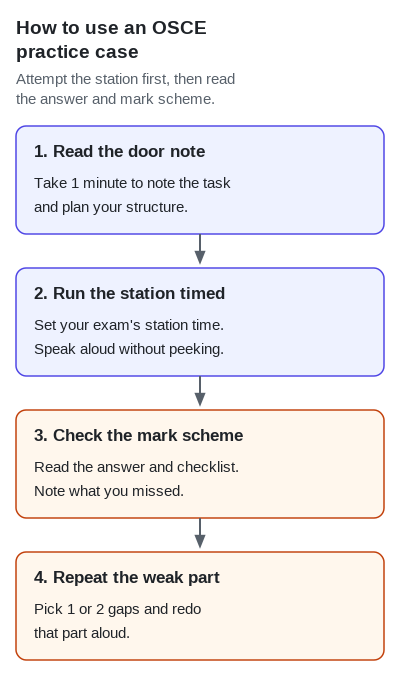
- Read only the door note first. Take 1 minute to note the patient's age, setting, and task, then sketch a structure.
- Run the station against a timer. Set it to your exam's station length and speak your questions, summary, and plan aloud without peeking.
- Read the answer and mark scheme. Each free case on Oscegen shows how the station is marked, including clinical points and communication items.
- Repeat the missed section aloud. Pick 1 or 2 gaps, such as missing a red flag or ICE, and redo that part.
For a full solo routine, read our guide on how to practice for OSCE stations on your own. You can also run cases on Oscegen with an AI patient that answers only what you ask. After the station, you present to an AI examiner and read a debrief that shows what to fix. All practice cases and simulated patients are for exam preparation only and are not medical advice.
Practice it
Browse all free written OSCE cases, answers, and mark schemes at oscegen.com/free-cases. For a balanced starting circuit across station types, try 1 case from each category below:
- Chest pain (history taking)
- Breaking bad news (communication skills)
- Suicidal ideation (mental health)
- Diabetes review (chronic disease review)
- Febrile child (paediatrics)
- Pregnancy bleeding (obstetrics and gynaecology)
When you are ready to run timed stations with an AI patient and examiner debrief, create a free account at oscegen.com/sign-up.
Sources
- General Medical Council (GMC). MLA content map (published October 2025, applies to MLA assessments from September 2026). https://www.gmc-uk.org/education/medical-licensing-assessment/mla-content-map
- Kurtz S, Silverman J, Benson J, Draper J. Marrying content and process in clinical method teaching: Enhancing the Calgary-Cambridge guides. Academic Medicine (2003);78(8):802-809. https://doi.org/10.1097/00001888-200308000-00011
- Baile WF, Buckman R, Lenzi R, Glober G, Beale EA, Kudelka AP. SPIKES: A six-step protocol for delivering bad news: application to the patient with cancer. The Oncologist (2000);5(4):302-311. https://doi.org/10.1634/theoncologist.5-4-302
- General Medical Council (GMC). Decision making and consent (2020, updated 3 August 2026). https://www.gmc-uk.org/professional-standards/the-professional-standards/decision-making-and-consent
- National Institute for Health and Care Excellence (NICE). NG225: Self-harm: assessment, management and preventing recurrence (2022). https://www.nice.org.uk/guidance/ng225
- British Pharmacological Society and MSC Assessment. Prescribing Safety Assessment. https://www.prescribingsafetyassessment.ac.uk/